|
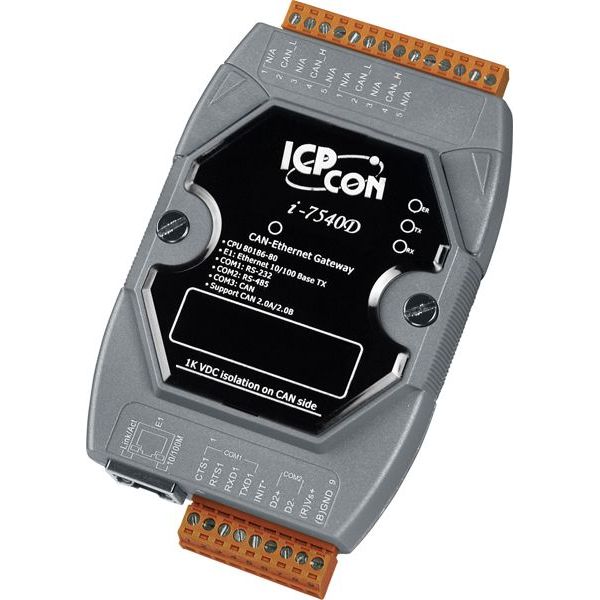
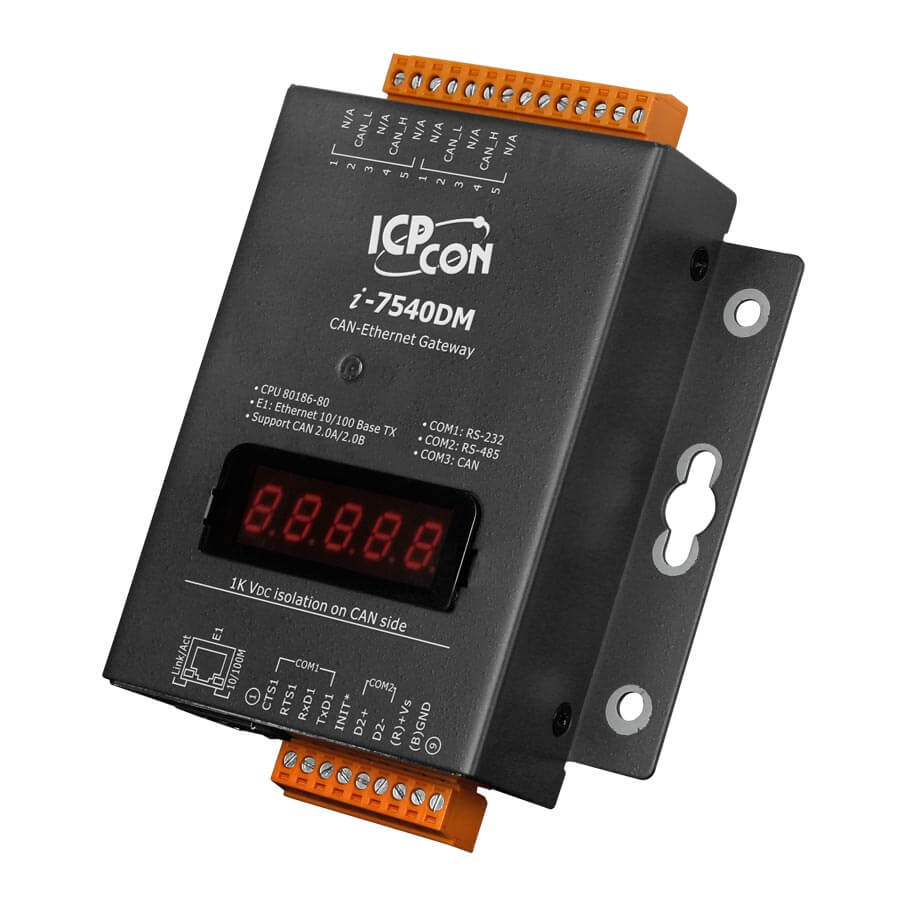
I-7540D & I-7540DM (CAN to Ethernet Gateway)
|
|
The I-7540D series are CAN to Ethernet converters, and are usually applied as an Ethernet to CAN/RS-232/485 Device Server. They support socket access functions and virtual COM port technology which helps users to get the CAN, RS-232, RS-485 data via virtual COM port. The I-7540D series also provide transparent mode, which enables CAN networks to be coupled together over the Internet/Ethernet, whereby remote monitoring and control is possible. By the features of tiny operating system, protocol independence, small casing and flexibility, it is able to widely fit various RS-232, RS-485 and CAN applications, which may be based on private RS-232 protocol, private CAN protocol, Modbus protocol, CANopen protocol, DeviceNet protocol or J1939 protocol. |
Request For Quotation
Description
Applications


Features
- Ethernet Protocols, TCP,UDP,IP,ICMP,ARP
- 10/100 Base-TX Ethernet Controller
- Message transmitted by using TCP/IP protocol and maximum 25
Ethernet client connections - COM driver support interrupt & 1K QUEUE Input & Output buffer
- Support one RS-232 port, one RS-485 port and one CAN port
- 2500Vrms photo-isolation protection on CAN side.
- Jumper select 120Ω terminal resistor for CAN channel
- Phillip 82C 250/251CAN Transceiver
- Support both CAN specification 2.0A and 2.0B.
- Max transmission speed up to 1M bps for CAN and 115.2kbps for RS-232 & RS-485
- Max transmission distance of CAN over 1000m (follow CAN specification)
- Built-in self-tuner ASIC controller on RS-485 port
- 7-segment LED display (for I-7540DM).
- Software or web configurable CAN and RS-232 communication parameters
- Firmware updated from COM1 or Ethernet port
- Support Web Configuration
- Support Virtual COM technology
Data Process
| The VxComm technology can be used to simulate COM/CAN ports of the I-7540D to become a COM port of PC . With the help of VxComm driver, users can access the remote COM/CAN ports of the I-7540 just as them would access the PC’s COM port. The block diagram of data processes in I-7540D is given as follows: |  |


